In this Labor Day pictorial essay, I believe I felt most like image #5 in my daily work before retirement.
http://todayspictures.slate.com/20120831/
Showing posts with label engineering. Show all posts
Showing posts with label engineering. Show all posts
Monday, September 3, 2012


Wednesday, March 21, 2012
Software Defined Radio Receiver: DC to 1,700 MHz!

Modern electronics is really capable of being tiny. If you look at the projects outlined here, equipment that used to be mounted in 19"-wide metal rack panels for the military when I was in the Navy in the mid-1960s is now able to fit on a thumb-drive-sized "dongle" that plugs into your USB computer port on almost any modern computer! And the abilities of this equipment to do things the older stuff couldn't do are near boundless. When I used the specialized receivers in small communications vans or containers similar to today's shipping containers for overseas commerce, I never expected this degree of reduction in size.
Here are some links to look at this equipment, if you are interested:
A UK project for SDR:
About page:
And an option for HF:
It may be old news to you, but I thought I'd share this.
Monday, January 16, 2012
Ending incandescent bulb production: Are LED bulbs the answer?
∙ ∙ ∙
I got an email today from a non-tech friend with this link in it.
http://www.asiapacificnews.
It gave me the opportunity to think about and compose an answer for that audience about my own major doubts about the state of LED bulb production as a successor for the ubiquitous incandescent illumination bulb. U.S. law caused the "phasing out" of all production of standard household incandescent bulbs beginning 1/1/2012.
http://www.usatoday.com/money/industries/manufacturing/story/2011-12-28/light-bulb-rules/52256656/1
Here is my reply to him...and to you:
Thanks for bringing that up. I first have a quote for you:
Quite a bit of the GeoBulb’s light is directional. It’s very bright directly underneath it, but if you move far off to the side, it’s not producing nearly as much incidental light as the incandescent bulb. For many situations, this isn’t a problem at all – recessed lights and lamps won’t skip a beat. However, for other uses (such as a single bulb that lights a small room), you may want to wait for next generation LEDs.
That is exactly the problem with LED bulbs. The physical function of how LEDs GENERATE light is behind the problem. Incandescent bulb filaments squirt out light as if from a point source. (Imagine a point in space that emits the same light as a 100W bulb in all THREE dimensions.) You can see the shape of the light intensity in this diagram. It is the large set of lines...just extend them all the rest of the way around the bulb.
The way an LED works is that the light is instead generated out from the SURFACE of the "semiconductor junction" that creates it. So, in the same mental state, imagine the light of a 100W bulb squirting out instead from the SURFACE of a tabletop straight up from it with some spread, but mainly only UP. Now think about how many tiny LEDs it would take to accomplish sending light in all the directions we use light from a generic home light bulb to illuminate! Being drastically efficient at squirting light out of a tiny hole (too simple, I know) is NOT the same as sending it effortlessly in all directions.

Part two of the problem is that in order to WORK, incandescent bulbs have to incandesce or get hot enough to glow white hot. So heat is part of what makes 'em work and the distribution and dissipation of that has been solved over the last 120+ years. But the heat generated by the LED function is the BANE of their existence. And dissipating it is one of the major problems standing in their way of being successful. The hotter they get, the WORSE they work. That is why the bottom part of most of the LED bulbs is a metal heat radiator. Having that metal all over the base is also one of the things that means they eat up lots of resources (metal production and crafting of the heat sink) to create. See the image below. That may be partially done away with by the top developmental quote where a company has new bulbs with liquid cooling.

In order partially overcome the part one above, the makers put many, many LEDs inside the bulb to attempt to squirt light out in several directions. But it takes a whole lot of "several" to equal "all", so they compromise by only squirting light vaguely less than that above some horizontal plane surface. That is the part of the quote about not having light off to the side of straight out the end of the bulb. This is shown by the 60º beam angle shown below where the light has already dropped off to only half what it is straight out the end of the bulb. This makes the bulbs seem more like spotlights instead of general light bulbs. If you are viewing really wide items, you might have to move the item you're viewing around to stay in the bright part of the light pattern. I do not like this.

1) LED's are very sensitive to the voltage used to power them (ie, the current changes a lot with a small change in voltage)
2) The required voltage changes a bit when the LED is put in hot or cold air, and also depending on the color of the LED, and manufacturing details.
Incandescent bulbs work over a fairly wide range, but their target brightness and effective color temperature is only achieved in a few volt range of the 120 volts we have from household power. But the above numbered statements say we can't power the LED bulb the same if it is in a 140º attic as we can when it is dangling outside in -10º blizzard. The circuits have to be very careful how they arrange this, which means NO direct application of the household power: there have to be electronic control circuits containing many components built into the base of the bulbs, thus adding complexity and room for failure of one of the tiny parts to ruin your whole $30-40 bulb, as there is no replacing parts inside the bulbs. They are manufactured so the parts are NOT replaceable by the consumer.
See how hard it is to explain the idea of what the makers of the WONDER LED BULBS gloss over in their gushing rush to get ya to buy their bulbs? These makers are trying really hard to get you to buy these darned bulbs at $30-40 a pop, but THIS EE is not havin' any o' dat. They have to get mucho better-o before I bite. And they darned well better get a heap cheaper.
Hope I didn't lose you in the discussion. I tried hard to keep it on a non-EE-level basis. But feel free to ask comment.
Tuesday, November 8, 2011
No fade, no run, no erase, no disappear

Here is a blog post that features a set of tests for a pen with which to write your lab notes, if you plan on them being around through some sort of accident after they are written. Several different kinds of pens are tested, and the winners of permanent writing are discussed.
Comments are welcomed.
Wednesday, December 1, 2010
Large solar arrays come to San Antonio


There are all kinds of negative comments coming the way of renewable energy projects. We went to San Antonio this week and saw this installation. It is impressively LARGE.
"The Blue Wing solar farm near San Antonio, Texas is operational and producing 16.6 megawatts of DC power (14.4 megawatts AC). It’s the largest solar photovoltaic (PV) facility in Texas and the third largest PV farm in the U.S. The amount of generation from the facility is approximately 25,000 megawatt-hours.
"The installation includes a 500-kilowatt demonstration facility where an assortment of thin film and crystalline silicon PV modules as well as a concentrating PV unit have been installed for research and comparison purposes." Quote from Juwi Solar.
Saturday, March 13, 2010
Having a ball with bearings

Having been closely involved with bearings since the 6th grade, I was nonetheless impressed with this short video telling of some of the myriad processes and machinery that make them happen in most of our devices that roll and spin and move about. Isn't technology fun?
Comments welcomed.
Sunday, January 18, 2009
Thoughts of genome and career pursuits
I was just reading a post by Bernie Latham at Brittle Hum of the Republic blog. It was this one, which describes a New York Times Magazine article by Steven Pinker, which is a really well-written discussion of where having personal knowledge of your own genome might take us as a society, once the price for reviewing and picking it apart is well within the discretionary income surround of the cognoscenti who can use the material.
He then wanders off to discuss how shaken he was when he was being interviewed and the interviewer asked him what caused him to take his particular career path. His stuttering reply then forced him to vow to himself to be better prepared the next time he was asked that question. Do YOU know the answer to your life's direction? What steered YOU to stumble or smoothly run down the path you've taken?
I am convinced my path toward getting my electrical engineering degree at UT, Austin, was finalized by the years I spent in an electronics-specialty Explorer post, sponsored mostly by the engineers at the headquarters of General Telephone of the Southwest in San Angelo, Texas. Well, that, coupled with getting my ham license at 16. Both of those things led me to spend my time with tubes and transistors, capacitors and transformers. My friends were mainly geeky electronics-speaking souls who might just as well mumble things in spoken Morse code as much as they might talk about the advantages of the Williamson amplifier.
Once I had all that firmly in mind, with the viewpoint of what the engineers told us they did for a living, and how we teens viewed their casual ability with the technical details of the electronics we loved so much, I was certain that electrical engineering was for me. Never mind that we were dirt poor, that there were no engineers in my family, that I had to run a morning paper route just to make it through high school. THAT was my goal. [It took a wavering path, with spots of poor performance due to lack of focus, and years of striving to make it all happen.]
He then wanders off to discuss how shaken he was when he was being interviewed and the interviewer asked him what caused him to take his particular career path. His stuttering reply then forced him to vow to himself to be better prepared the next time he was asked that question. Do YOU know the answer to your life's direction? What steered YOU to stumble or smoothly run down the path you've taken?
I am convinced my path toward getting my electrical engineering degree at UT, Austin, was finalized by the years I spent in an electronics-specialty Explorer post, sponsored mostly by the engineers at the headquarters of General Telephone of the Southwest in San Angelo, Texas. Well, that, coupled with getting my ham license at 16. Both of those things led me to spend my time with tubes and transistors, capacitors and transformers. My friends were mainly geeky electronics-speaking souls who might just as well mumble things in spoken Morse code as much as they might talk about the advantages of the Williamson amplifier.
Once I had all that firmly in mind, with the viewpoint of what the engineers told us they did for a living, and how we teens viewed their casual ability with the technical details of the electronics we loved so much, I was certain that electrical engineering was for me. Never mind that we were dirt poor, that there were no engineers in my family, that I had to run a morning paper route just to make it through high school. THAT was my goal. [It took a wavering path, with spots of poor performance due to lack of focus, and years of striving to make it all happen.]
Friday, December 12, 2008
The Anti-Ky-WHAT?
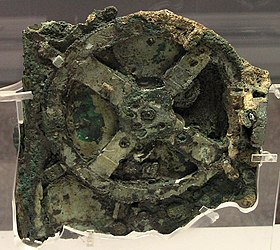
For those who've been keeping up with all the controversy and discussion of what the 2,000+ year old Greek device (Antikythera) found, crusty, rusty, and decrepit in the body of a sunken ship must have been originally used for, here is a video of a model a museum curator (Michael Wright) has constructed that includes all the known functions that have been identified for this old device. It is thought in some circles to be the first analog computer, though it is unlikely that this device was not based on earlier devices that used some of its principles. He constructed it in his workshop, which MUST be rather better filled with construction devices than mine is. You can see more about it here.
Friday, October 24, 2008
British speed to change: rocket car

Today I read a blog entry about a new Brit effort to capture the imagination of school children in order to convince them that they should pour their future educational efforts into science and engineering directions. A 1,000+ mph ground vehicle and huge engineering feats are planned.
The effort involves years of effort. Many people are involved in this endeavor (some of whom might lose their lives in the process...or gain fame; some may lose their fortunes...or gain more). The designers even think the possible future of their nation is at stake in some sense. They posit that if something like this isn't done, the country will sink into a morass of little expansion of ideas and become technologically moribund.
All this effort is based on adults' views of what the children of today are going to do with the world presented to them as they come into adulthood. It is a view that is slanted by the kids they see spending all their time with video games, growing less interested in the world around them (as represented by science) than the world of fantasy and play.
However, the world has always seen children play and use fantasies to either escape or deal with the harsh realities they see around them on their way to adulthood. I suppose these fellows see today's children as never giving up their play and fantasies in order to deal with the real world they will find as adults.
Is all this placing too much into these fellows' read of the path of growth of today's children? Will lives be sacrificed in vain? Fortunes squandered for nothing? Your comments are welcomed.
Monday, September 1, 2008
Nixies from the Nixon era: for your profound messages to the world
A fellow electrical engineer has created what he calls his "Nixie Shoutbox" for those in the know to shout their profound statements to the world. They only run for a little while, then the display goes back to date and time. The plasma gas display tubes were designed for a stock market display back in the 1960's. I've enjoyed interacting with the owner and his cat (who are sometimes visible in the videocam from which you view this engineering wonder) as well as having conversations with other ham radio operators on the nixies, treating them like radio conversations.
The builder got his impetus for building the device from this page, which is filled with nixie devices. He was kind enough to send a very long list of similar devices in a mail today.
If you poke around on his site, you can see a photo list of how he built his device and you can look around his place, which is out in California, using the site's remotely controlled video cameras for looking at his sleeping cat or through the windows for a nice night view of nearby buildings.
The builder got his impetus for building the device from this page, which is filled with nixie devices. He was kind enough to send a very long list of similar devices in a mail today.
If you poke around on his site, you can see a photo list of how he built his device and you can look around his place, which is out in California, using the site's remotely controlled video cameras for looking at his sleeping cat or through the windows for a nice night view of nearby buildings.
Subscribe to:
Posts (Atom)

 Posts
Posts


