Showing posts with label from MAKE blog. Show all posts

Tuesday, November 8, 2011

No fade, no run, no erase, no disappear


Here is a blog post that features a set of tests for a pen with which to write your lab notes, if you plan on them being around through some sort of accident after they are written. Several different kinds of pens are tested, and the winners of permanent writing are discussed.

Comments are welcomed.

Tuesday, November 30, 2010

Ideas for a "Homemade Christmas"


My friend, Gary, said:
Avoid the "Great Gift Card Exchange" AKA "Money Swap"..... here's a starting place.... http://www.instructables.com/community/Letter-from-the-Editor-Homemade-for-the-Holidays/

To which I added:
Here are more thoughts for the homemade gift group:
Hand scrub with lemon
http://blog.craftzine.com/archive/2009/05/mothers_day_homemade_hand_scru.html
Homemade gift contest winners
http://blog.makezine.com/archive/2007/01/homemade_gift_contest_win.html
More gifts to make
http://blog.makezine.com/archive/2008/11/instructables_diy_gift_id.html
Gift cards you can make
http://blog.craftzine.com/archive/holiday_projects/?p=2
Gifts for "foodies" on your list
http://blog.craftzine.com/archive/2009/11/gifts_for_foodies.html
If you have a youngster, this might be interesting:
http://www.instructables.com/id/Kinetic-Marble-Track-Around-The-Top-Of-A-Room/

Whatever you have in mind beyond these ideas, you are welcome to make a comment here.

Wednesday, October 13, 2010

$3 million worth of elapsed time = 3.5 days!


This expenditure seems to pour forth in front of your eyes in 12 minutes. It was actually a fellow with an overlook of the work done at Church and 30th in San Francisco to replace the intersecting streetcar tracks in a public works extravaganza for the householders whose houses are there. He says they were provided with earplugs for the duration.

I think I would have probably gone somewhere on a short vacation or found some place else to stay until it was over. However, this time lapse photography video is fascinating to watch. He used a Canon A590is camera with some software written by others and installed temporarily on boot-up via the SD card used to record the 18,520, automatic-setting photos to create the video. I found out about it via MAKE: blog.

Tuesday, October 12, 2010

Kindle: Please not for the short of thought!

Are we ready for Kindle to be the "Short Attention Span Theater" of this portion of the 21st century? I am seriously hoping not. That's what we have quick-cut TV shows for, to mentally jerk your head (and mind) this way and that, so you can't think of something for more than a couple of seconds at a time. There are those to whom this has become more than a way of life: they seek that experience throughout life and, thus, miss out on ALL of life that takes careful thought and rumination to take in and build upon.

If you are wondering what I'm talking about, check THIS LINK out.

Comments welcomed.

Tuesday, September 8, 2009

Garden benches from chairs


This looks like a really good way to re-purpose old pipe-frame chairs into garden benches. I saw this today on the MAKE: blog.

Thursday, August 20, 2009

Cardboard "Frisbee"-like device


Well, Frisbee is is NOT. But this project from Make:/Instructables is cool looking. Maybe you would like to make one? The link shows how to do so.

Comments welcomed.

Monday, June 29, 2009

Electronics parts yield articulated animal robots

I ran across this post today on the MAKE: blog that discusses robot art pieces that are fashioned from large numbers of electronics and mechanical parts into the most interesting animals you can imagine. Very imaginative and inventive, to say the least!

I was following some of the links about this and I found this post of the artist's own making, that takes a few of the robot pieces even further to make extremely short videos of them going through their articulated paces! They amazed me no end!

Comments welcome.

Thursday, June 18, 2009

Amazing software for my Canon S3 camera


I stumbled onto this software site tonight. I have a hard time explaining how wonderful this software add-in sounds to me. There are a number of things that I've been wanting to do and was disappointed that my camera couldn't do that now are possible through this software!

If you want to read about it, the main page is here.
I found out about it through a kind of roundabout means. I read the MAKE: blog. It is a blog for folks who enjoy making things. The post I read on that blog is interesting enough. It is about making an automated robotic device that allows you to create panoramic views with your digital camera at the push of a button. The post is here.
While I was reading it, it linked to the actual construction instructions here.
And on that first page of the 13 steps to make the robotic controller, the CHDK program was mentioned. I did not know before that moment that anyone was mucking about, adding software TO the already existing instruction set inside my Canon camera. I wouldn't have thought of it, though that is the domain of a lot of the MAKE: projects: "hacking" or changing either hardware or software of modern devices to make them do things they couldn't before or extending the possibilities of the device far beyond the manufacturer's thinking. CHDK makes use of the microprocessor that controls the camera (every digital camera contains a microprocessor) to act as a programmable computer that provides the extra capabilities.
This software does that with a vengeance! Here's a partial list of things possible through using CHDK, divided into six categories:
a. Enhanced ways of recording images - you can capture still pictures in RAW format (as well as JPEG), and for video images you can have increased recording time and length (1 hour or 2 GB), and a greatly increased range of compression options.
b. Additional data displays on the LCD screen - histogram, battery life indicator, depth of field, and many more.
c. Additional photographic settings that are not available on the camera by itself - longer exposure times (up to 65 seconds), faster shutter speeds (1/25,000 sec, and faster in some cases), automatic bracketing of exposure, etc.
d. The ability for the camera to run programs ('scripts', written in a micro-version of the BASIC language) stored on the memory card - these programs allow you to set the camera to perform a sequence of operations under the control of the program. For example, a camera can be programmed to take multiple pictures for focus bracketing, or take a picture when it detects that something in the field of view moves or changes brightness.
e. The ability to take a picture, or start a program on the memory card, by sending a signal into the USB port - you can use the USB cable to take a picture remotely.
f. The ability to do a number of other more useful (and fun) things, such as act as a mini file browser for the memory card, let you play games on the LCD screen, etc.
And (just think about it), the possible things that the software can do for the camera and user may GROW in number, because, now that the genie is out of the bottle, there are a host of folks out there, poking and prodding away in multiplicities of experiments, trying to create new features no one else has thought of. I'm boggled...and excited...and anticipating my camera getting much more use.

Monday, June 1, 2009

Time for Three Laws to Step In

I just saw this post and thought to myself, "Yeeks!" This device is definitely a human add-on that could inflict rather dire damage to humans if not properly controlled. It is not yet tied to an independent controller, but some safety features would certainly be nice to see. /sweat begins to roll off forehead/

Here are posted some of Christian Ristow's machines.

Comments?

Friday, May 29, 2009

Get the rust out

I was reading the MAKE: blog today and found this tidbit of helpful shop lore in the links to the Instructables site. I'm passing it along to anyone who might have OOPSed their way into having items covered in rust, due to unfortunate mental meanderings.

Here's the introduction to the effort:
This is a relatively simple, safe and cheap way to remove light or heavy rust from any ferrous object. I used this process to restore an old wood plane that I bought for $1 (it looked totally un-usable because of the rust). As opposed to grinding, heavy wire brushing and acid bath processes, this method removes none of the original steel and is not noisy or caustic.
Comments?

Saturday, May 9, 2009

Robot bartenders and liquor organs


The wonderful Make blog contains this piece about robot bartenders:
http://blog.makezine.com/archive/2009/05/robot_bartender.html

And separately:

"Gallegher Plus"

(May 31, 2004)

From the November 1943 issue of ASTOUNDING, this is one of the five 'Gallegher' stories by Henry Kuttner. (Although they were first published under the Lewis Padgett name, his wife C.L. Moore has said she had nothing to do with writing these stories; a bit unusual, as the two usually collaborated on most of what they wrote.)

These tales are very clever and well constructed, with a surreal sense of humour. I personally found them more amusing than hysterically funny, but of course we all have different ideas on what's hilarious or not. The basic premise is that a young man named Galloway Gallegher drinks pretty much nonstop. When completely sotted, his subconscious comes to the surface and takes over but, instead of being a monstrous Mr Hyde, this Gallegher Plus is an inventive supergenius who cobbles together astounding devices from materials at hand.

The next morning, crawling about poisoned by his hangover, the regular Gallegher is faced with a bizarre invention he has no memory of constructing and which he has to deal with. Since our hero has absolutely no technical knowledge, he is completely lost when faced with this unlikely gizmos. One such invention is the recurring sidekick in the series, a narcissistic robot called Joe. (Joe by the way is a delight, obsessed with his own mechanical beauty and filled with withering remarks about we repulsive meat creatures. "I'll get you a robe. Your ungainly body offends my aesthetic feelings," he informs his creator, fresh from the shower.

In this particular tale, Gallegher is suffering his usual morning hangover as he realizes that most of his backyard was vanished, the soil apparently vaporized by a goofy looking contraption he must have worked up the night before. Giving the matter some urgency, Gallegher finds he has promised to come up with inventions requested by three different people, all of whom advanced him large sums of money he no longer has. Faced with summonses to appear in court and harassing messages from his clients, Gallegher has to muddle through the situation and solve all his
problems at once.

What makes the stories funny is that the dayime Gallegher (who is usually partly sober) has no memory of what the soused Gallegher Plus was up to. He has to go about his business as if he knows what's going on, making him something like a detective trying to solve his own mystery. In this particular case, after much turmoil and tense moments, he finds out the answers to the demands from all three clients are right in front of him. And he also learns why the gizmo plays "St. James Infirmary" while it's functioning....

The story seems to be set in some indeterminate near future – there are references to things like taxiplanes and dashboard teledirectories, as well as a man being hard to reach because he's away on Callisto – but it's not really necessary. Except for a few inessential details, we might as well be in 1943 Manhattan from the way everyone talks and acts. A man in a derby playing pinball in a saloon.... that's really not a futuristic image.

What gives the Gallegher stories a slightly bizarro atmosphere is the nonjudgmental attitude of the characters (and the narrator) toward our hero's alcohol habit. For at least the past ten or fifteen years that I've noticed, popular entertainment has really been dead set against drinking and smoking. Watching the Thin Man movies from the 1930s (where Nick and Nora seldom put down their glasses) or reading detective stories from the 1940s (where Mike Shayne seems to function better with brandy than with any sleep), I'm amazed to recall that until fairly recently, getting drunk was considered fairly amusing. (Remember that guy on the Jackie Gleason show who sang a beautiful song while plastered?)

Gallegher carries this to an extreme, even for that more tolerant period. It`s not like he's cold hard sober most of the time and just becomes Gallegher Plus after two martinis. No, this boy is hitting the sauce constantly. He has set up a "liquor organ" by his couch which dispenses various combinations of booze through a tube. At one point, he goes with a shady character on an alphabetical barcrawl ("You start with A – absinthe – and then work along, brandy, Cointreau, daiquiri, egg flip..."). They have to fudge a bit here and there, and must start all over after realizing they skipped 'N'. Egads, I can only imagine synthetic livers are inexpensive and readily available in this era.

Aside from being an ingenious puzzle story, in which the hero has to figure out what his other self did, while pretending to be on top of things, "Gallegher Plus" is filled with amusing little touches. The vain robot Joe says he will allow people to watch him dance if they wish, but at the same time he has no problem with the idea of breaking a few heads ("I like blood. It`s a primary color.") Four Gallegher stories by Henry Kuttner appeared in ASTOUNDING in 1943, with a fifth in 1948. They were collected in an anthology with the puzzling title ROBOTS HAVE NO TAILS. Now, if someone would only gather his Hogben stories about the superpowered hillbillies into one book...

Above quote excerpted from this page.

Saturday, May 2, 2009

Bending plastic for fun and use


I ran across this interesting how-to video today. Having a pile of scrap Lexan, my ears perked up. Making covers for keyers and other projects interests me, as well as short stands to support a ham radio transceiver while leaving room for a Morse paddle or notepad beneath it. Now, I just have to find an old hair dryer and some plaster of Paris to try it out.
http://blog.makezine.com/archive/2009/05/bending_plexiglas.html

More technical information on the material can be found at
http://en.wikipedia.org/wiki/Acrylic_glass
http://en.wikipedia.org/wiki/Lexan

Sunday, April 26, 2009

This ole house


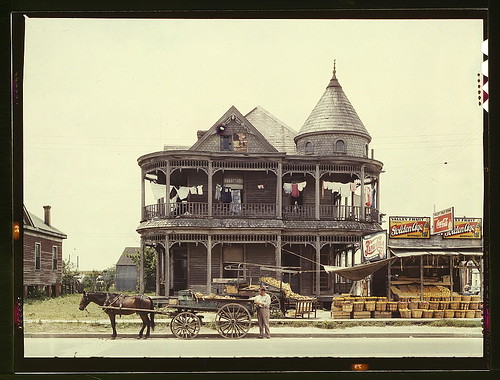
This is another of the wonderful images from the same collection as the last post. This one is from a place that commenters say is now practically downtown Houston, though in May of 1943 it doesn't appear to be quite the busy street that it likely is now.

I like the wraparound porches, the turret, the laundry, the spilling over of the baskets of fruit to the front of the house and the soft drink advertising on the store. I like the delivery wagon and the horse. The composition is excellent.

Comments?


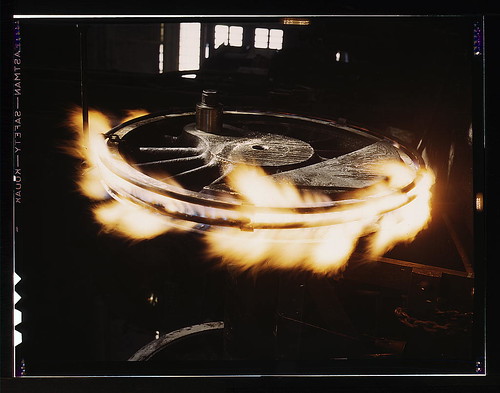
This display of photos from much earlier times
needs folks to view it. The example image I included above is a good example, though there are both images of things and people in it. One person who commented on the photo decided it should have been called, "Burning Ring of Fire". That appealed to the punster in me.

But the image itself is a thing of beauty. This image shows a moment in the process of putting a new steel tire on a locomotive wheel. (Who knew they even DID such things?)

Comments? (either this shot or the whole of the collection)

Tuesday, March 24, 2009

TED: Useful world improvements


This talk and its goals seems to me to fit in with the TV channel LINK-TV and its view of how the world can be made a better place without wars and destruction. Her work with students at MIT and field trips to Haiti have found ways to keep from killing 2 million children a year by mixing farm waste to create safer cooking fire materials. Seems funny that such simple solutions may have such far-reaching effects in parts of the world, but isn't it great that there are people like Amy Smith around to work on such things?

Thursday, February 26, 2009

Engineering Technology: The 3D printer revolution

Jay Leno (of Jay's Garage) hosts this video telling of THE solution to keeping ancient cars and steam engines running FOREVER. All those one-of parts that folks needed when something breaks can now be made (in the U.S.A. with U.S.A. machines...no having to send the gear or other complex part off to India to be copied!).

I'm impressed. Comments? (add yours below)

World gives adversity & lemons: make mermaids


One surely doesn't expect a story of asking and finding to be so positive in these days of financial ruin and the muck and mire of finances. But this story from New Zealand and the MAKE Magazine blog makes one's heart expand with hope and a smile grow and grow. Steve Unwin's amazing photo of the protagonist, Ms. Nadya Vessey, seems like something out of a fantasy story. And that is probably how she sees it. From a chance reply to a young child, the idea grew until an opportunity arose to make it a reality. She posed for the photo above, which appeared in the Dominion Post newspaper in the article by Matt Calman.

Wednesday, February 11, 2009

A Chinese keyboard factory: working rules

Sometimes WE think we have life hard. In this post of a report on working conditions in a Chinese factory that produces computer keyboards, we see almost every draconian regulation possible.

I'm not moving there to work.

Monday, February 9, 2009

Home Build of UHF TV Antenna


The author of this article asks a pertinent question, "Why would anyone even want to build their own TV antenna?" The answer is twofold:
1. lower VHF TV channels are moving up to UHF during the digital conversion
2. this antenna gets a better signal to the TV than most commercially available antennas.

It is built out of easily-available parts and doesn't look like it takes any machine shop to make it happen. Anyone getting the gumption to make it happen, please report back here via comment.