I was talking with our small town's city secretary. We had recently been at the city council meeting together. She announced proudly that her learning curve included results for my asking repeatedly for the past council minutes and the next meeting's agenda to be posted on the town's (mostly unused) Web site for all to see and evaluate. Current custom was to post the agenda pages on the City Hall front window with tape, so interested parties could peruse the agenda. Minutes were mostly unavailable to the public.
When even small towns are getting onto the Web with more than just place markers, it is a good sign to me that more universally available information about them is being promulgated and that government is becoming more open. When only the people who know where to ask and wheedle and beg and plead to see minutes of public meetings are rewarded with a few pages (with possibly a per-page charge, depending on the government involved) vs. just cranking up a browser and looking for anyone knowing or asking ONE time for the page address, I feel like progress is being made.
Now, I'll start asking for inputs for citizens on that Web page, like question & answer and reporting problems around town. Things like the state transportation department's video camera that sets when the light turns red has not been changed since a street became one-way. That means folks wanting to turn left onto the town's main street were rewarded with waiting until forever for the light to turn green for their turn. Or another newly one-way street had a missing sign to notify motorists who might have turned into oncoming traffic without the warning the sign allows. Or a school crossing sign with a missing bolt that's now swinging upside down across the street from our house. The government is nothing without the eyes and ears of the populace to help them keep up with what needs fixing.
Stand by for the progress evident in the new decade, in spite of poor economic conditions.
Comments are welcomed.
Thursday, March 25, 2010


Saturday, March 13, 2010
Having a ball with bearings

Having been closely involved with bearings since the 6th grade, I was nonetheless impressed with this short video telling of some of the myriad processes and machinery that make them happen in most of our devices that roll and spin and move about. Isn't technology fun?
Comments welcomed.
Monday, February 15, 2010
I am not a futurist

This blog post essay is from a science fiction author from Britain.
You can verify her post's contention by rereading lots of the 50's and 60's SF (or a smattering sample thereof) to see that, although they write about a far-distant future for the most part, they are writing ABOUT today's issues and concerns.
Even if authors try hard to think they are cutting edge or beyond when they write about the future, if they are going to be successful, they HAVE to write for the audience who will read or purchase their material. As an example, it would have been fairly fruitless for someone in the 1920's to write a body of literature exploring a future with race relations as we find them in the 21st century reality. The world and the reading public just was not ready to embrace the ideas that underlie the day-to-day workings of our world.
Comments are welcomed.
Wednesday, January 27, 2010
Boggled by farads

For technical or physics-minded folks: Recall when the news of a big capacitor was that a 0.5 to 1.0 farad capacitor would fill a good-sized barn? Well, I just heard from an old friend that there is this news that this company is now selling capacitors that are up to 5,000 farads in value!
As the friend puts it: "And I don’t mean 5000 units of a one farad capacitor… That’s 5,000,000,000 microfarads/part!
But (and here's possibly one catch for some practical uses for these parts to replace batteries for emergency operations), the parts are rated at 2.7 volts.
Comments are welcomed.
Monday, January 11, 2010
Generation gap squeeze: Children in cyberspace

This NYTimes article about the social aspects of today's children, their interaction with electronic connections to cyberspace, the expectations they will have from those interactions, and what it will mean about the social divides between children only a few years apart in calendar age is a fascinating hypothesis and a disturbing one on the level of what it might mean in disruption to our society.
We who are older might be tempted to not think about this situation if it were not for articles like this which call it to our attention.
Comments welcomed.
Sunday, January 10, 2010
50,000 hp in a used F-104 Starfighter body: Aiming for 800 mph on land!

When I used to take my mother's 1954 Plymouth out on the soon-to-open loop on the west side of San Angelo, Texas, I had nothing like this baby in mind. This fellow has lots of folks helping him get things lined up right, since there's not much margin for error at land vehicle velocity beyond the speed of sound. But the idea of cranking up 50,000 hp and lettin' 'er rip is somewhat attractive. The idea of death or months of hospital recovery if there's a mistake doesn't seem in the same breath, so to mentally speak. The subject says what happened and the plans for the future. Read the article for details.
Whoosh! Shazam!
Comments welcomed.
Sunday, January 3, 2010
Old plaster walls yield no WiFi & little cell signal
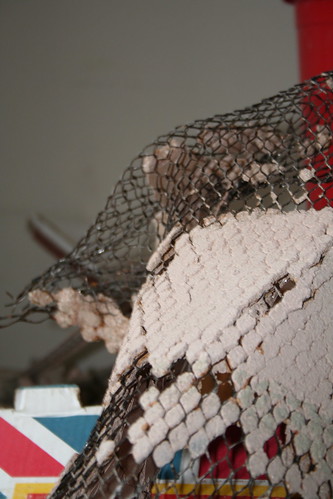
Many of the places I lived in west Texas as a child had provisions for keeping chickens. I would never have thought of this problem back then. But, those places NEVER had plaster walls; they only had the wire in chicken coops.
Subscribe to:
Posts (Atom)

 Posts
Posts


